
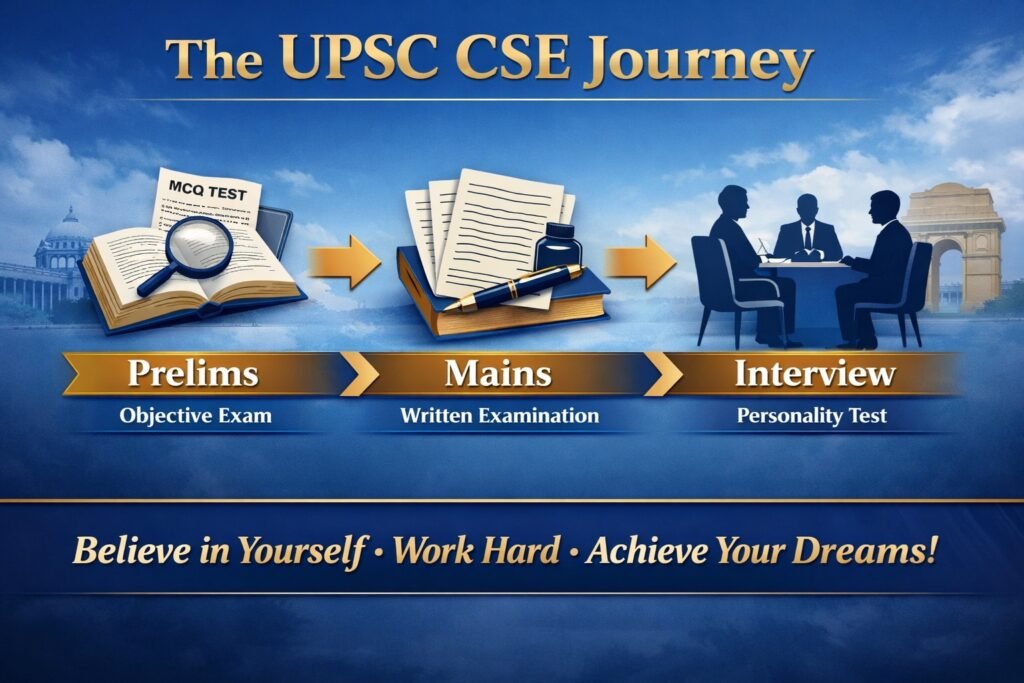
Dreaming of serving the nation as an IAS, IFS, or IPS officer? Your journey begins with the Civil Services Examination (CSE), one of the most prestigious and challenging competitive exams in India. Conducted annually by the Union Public Service Commission (UPSC), this exam is your gateway to top administrative roles in the Indian government.
Don’t let the complexity intimidate you! Every successful officer once stood where you are now. With the right strategy, dedication, and a clear understanding of the exam pattern, this mountain is absolutely scalable. This guide will walk you through the entire 3-stage process, equipping you with the essential knowledge to start your preparation confidently.
The Three-Stage Marathon: Prelims, Mains, and Interview
The UPSC CSE isn’t just a test; it’s a comprehensive assessment spread over approximately a year, totalling about 32 hours of rigorous testing. It’s designed to evaluate not just your knowledge, but your analytical ability, ethical compass, and personality.
The process unfolds in three distinct stages:
- Preliminary Examination: The first hurdle, an objective screening test.
- Main Examination: The core test, consisting of detailed descriptive papers.
- Personality Test (Interview): The final assessment of your suitability for a career in public service.
Let’s break down what each stage entails.
Stage 1: The Preliminary Exam – Your First Hurdle
The Prelims is a qualifying stage. Its marks don’t count for your final ranking, but clearing it is mandatory to proceed to the Mains. Think of it as the gatekeeper to the main arena.
Here’s what the UPSC Prelims pattern looks like:
| Exam Component | Details | |
|---|---|---|
| Total Papers | 2 | |
| Papers | General Studies Paper-I & General Studies Paper-II (CSAT) | |
| Number of Questions | GS Paper-I: 100 | CSAT: 80 |
| Total Marks | 400 (200 each paper) | |
| Negative Marking | Yes, 1/3rd marks deducted per wrong answer | |
| Time Allotted | 2 hours per paper |
Key Takeaway for Aspirants: While CSAT is qualifying in nature (you need 33% to pass), GS Paper-I is the king. Your performance here determines your rank for the Mains cutoff. Focus intensely on a wide-ranging syllabus covering History, Polity, Economy, Environment, Science, and Current Affairs. Pro Tip: Practising previous years’ question papers is non-negotiable to understand the trend, question style, and to manage time effectively.
Stage 2: The Main Examination – The Real Test of Depth
This is where your analytical writing skills, knowledge depth, and clarity of thought are tested. The Mains consists of 9 written papers held over several days.
A Snapshot of the UPSC Mains Exam Format:
| Paper Name | Duration | Marks | Nature |
|---|---|---|---|
| Paper A – Indian Language | 3 hrs | 300 | Qualifying |
| Paper B – English | 3 hrs | 300 | Qualifying |
| Essay | 3 hrs | 250 | Merit |
| GS I, II, III, IV | 3 hrs each | 250 each | Merit |
| Optional Paper I & II | 3 hrs each | 250 each | Merit |
| Total (Written) | 1750 | ||
| Interview | 275 | ||
| GRAND TOTAL | 2025 |
Understanding the Structure:
- Qualifying Papers: Paper A (an Indian language) and Paper B (English). You only need to secure the minimum marks prescribed by UPSC. Their scores are not added to your final total.
- Merit Papers: These are the game-changers! The Essay, four General Studies papers, and two papers from your chosen Optional subject. Your scores in these seven papers (totalling 1750 marks) are crucial for your final rank.
Strategy Insight: The Mains demands a different approach than Prelims. It’s about structured answers, critical analysis, and presenting arguments coherently. Building a strong foundation in your Optional subject and mastering answer writing for GS are the twin pillars of Mains success.
Stage 3: The Personality Test (Interview) – The Final Frontier
Carrying 275 marks, the interview is not a test of factual knowledge (that was the Mains!). It’s an assessment of your mental calibre, critical thinking, social traits, and leadership potential. The panel aims to see if you have the personality suited for the demands and responsibilities of a civil servant.
Be prepared to discuss your Detailed Application Form (DAF), current affairs, and your perspectives on a wide range of issues. Clarity of thought, honesty, composure, and a problem-solving attitude are highly valued.
Your Journey Starts Now: An Encouraging Word
Looking at the sheer breadth of the exam can be overwhelming. But remember, every officer you admire started with the same syllabus and the same 24 hours in a day.
Here is your action plan to begin:
- Know the Syllabus Inside Out: Get the official UPSC syllabus. It’s your roadmap.
- Build a Foundation: Start with standard NCERTs and basic books for core subjects.
- Embrace Current Affairs: Make reading a reputable newspaper a daily habit.
- Practice Relentlessly: For Prelims, solve mock tests. For Mains, write, write, and write more answers.
- Choose Your Optional Wisely: Select a subject based on interest, background, and availability of resources.
The UPSC journey is a marathon of consistent effort, smart strategy, and resilient spirit. There will be challenges and setbacks, but each one is a lesson that prepares you better. Trust the process, believe in your hard work, and stay focused on your goal of serving the nation.
The first step is always the hardest. Take it today. Your future in the civil services awaits.
Start preparing, stay consistent, and conquer the dream!